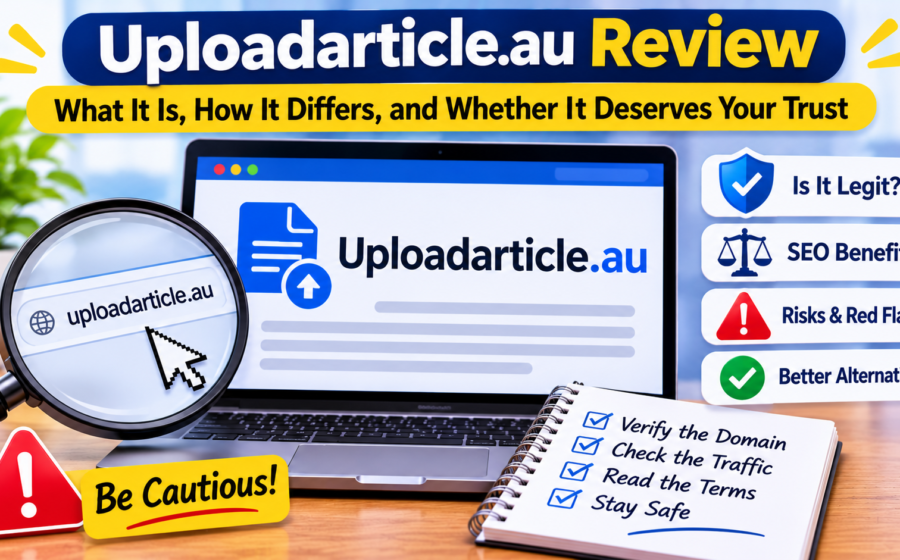
If you searched for uploadarticle.au, you probably want answers to three questions. What is this site? Is it the same as uploadarticle.com? And will publishing an article there do anything for your rankings?
The honest answer is that public information about this domain is thin. Most pages that rank for the name are written to capture search traffic, not to verify anything. This review separates what can be confirmed from what is only claimed, gives you a checklist to evaluate the site yourself, and lays out what US-based writers and marketers should do instead if the evidence doesn’t hold up.
What Uploadarticle.au Is and What the Public Data Shows
The Basic Description
Third-party site profiles describe the domain as a platform for submitting and sharing articles across many topics, with an emphasis on user-generated content. That is the extent of the neutral description available. There is no widely cited ownership statement, editorial policy, or documented publishing standard attached to it.
In plain terms, it presents itself as an open article-submission site. These sites let registered users publish posts, usually in exchange for a link back to their own website.
The Traffic and Authority Snapshot
A traffic-tracking profile of uploadarticle.au shows roughly 60 monthly visits, all attributed to Australia, with a Domain Rating of 0 and a single referring website. The same profile shows a drop of about 7,500 visits from the previous month, so traffic may have been higher recently and then collapsed. Estimates from tools like this are rough, but the direction is clear.
| Metric | What the profile shows | What it means |
|---|---|---|
| Monthly search traffic | About 60 visits | Almost no organic visibility |
| Traffic by country | 100% Australia | No US audience to speak of |
| Domain Rating | 0 | No measurable backlink authority |
| Referring sites | 1 | Almost nobody links to it |
| Recent trend | Large decline | Unstable or losing visibility |
A site with a Domain Rating of 0 and almost no audience cannot pass meaningful authority to anyone. A link from it is, at best, neutral.
Uploadarticle.au vs. .com, .com.au, and theuploadarticle.com.au
Several similarly named domains compete for the same searches. The traffic profile for uploadarticle.au names uploadarticle.com.au, uploadarticle.com and theuploadarticle.com.au as sites ranking for the same keywords. They look alike, but you should not assume they share an owner, rules, or reputation.
| Domain | Reported description | Reported authority |
|---|---|---|
| uploadarticle.au | Article submission and sharing platform | DR 0, about 60 visits |
| uploadarticle.com | Platform for sharing and publishing articles | Listed with a Domain Rating of 4.5 |
| uploadarticle.com.au | Appears as a competing domain for the same terms | Not confirmed |
| theuploadarticle.com.au | Article site covering lifestyle, technology, health and other topics | Not confirmed |
Why the Confusion Matters
Lookalike domains cause real problems:
- Wrong account, wrong site. You might register or submit on a domain you didn’t intend to use.
- Phishing risk. Near-identical names are a standard tactic for credential theft. Never reuse a password from another service.
- Muddled reputation. If one domain is penalized or flagged as spam, people tend to lump the others in, fairly or not.
- Unreliable reviews. A positive or negative write-up may be about a different domain than the one you’re checking.
Before you do anything, confirm the exact domain, including the extension, in your browser’s address bar.
What Other Guides Claim and What They Leave Out
Most of the pages ranking for this term are written in the same pattern. One guide promises to explain how the platform works, how to register and log in, and whether it is still effective in 2026. Others list benefits like backlinks, brand visibility, and niche publishing.
The typical claims are:
- Registration is free and takes a few minutes with email confirmation.
- Articles can cover business, technology, insurance, lifestyle, relationships, and digital marketing.
- Contextual backlinks improve search visibility.
- A “hot” section promotes popular posts, and posting every few days helps you get featured.
The problem is what these guides don’t provide:
- No ownership information. None name who operates the site.
- No proof of results. There are no before-and-after rankings, indexing tests, or traffic data from published posts.
- No link-attribute information. They don’t say whether outbound links are dofollow, nofollow, or sponsored.
- No risk discussion. Google’s guidance on link schemes and low-quality content is never mentioned.
- No US relevance. The audience data points to Australia, yet many of these guides claim broad international value.
Several also stuff dozens of keyword variants into one page, which reads like search bait. A guide that can’t tell you who runs a site is not a reliable source on whether to trust it.
Is Uploadarticle.au Legit? A Seven-Point Check You Can Run Yourself
Legitimate does not mean useful. A site can be harmless and still worthless for SEO. Use these checks to decide on both counts.
| Check | How to do it | Warning sign |
|---|---|---|
| Domain age | Run a WHOIS lookup | Registered very recently, or ownership fully hidden with no contact path |
| Editorial standards | Look for submission guidelines and a moderation policy | Anything gets published |
| Content quality | Browse ten random recent posts | Spun text, thin posts, unrelated topics side by side |
| Outbound links | View source on a few posts | Many commercial links per article, repeated exact-match anchors |
| Link attributes | Inspect the link code | No rel attribute at all on paid or promotional links |
| Indexing | Search a distinctive sentence from a recent post in quotes | Posts don’t appear in Google |
| Contact and policy pages | Check for a real address or working contact method | Dead or missing pages |
How to Read the Results
If a site fails several of these, treat it as a link farm. If it passes most but still shows no traffic, treat it as harmless but pointless. The data above for uploadarticle.au points to the second category at best.
Does Publishing on Uploadarticle.au Help SEO?
What Google Says About This Kind of Link
Google’s spam policies name nothing specific about this site, but they do address the practice it represents. Their link spam guidance lists large-scale article marketing and guest posting campaigns with keyword-rich anchor text as manipulative. Google also advises marking paid, sponsored, and user-generated links with rel=”sponsored”, rel=”ugc”, or rel=”nofollow” so they don’t pass ranking credit.
That creates a bind for open submission sites:
- If the links are properly attributed, they pass little or no ranking value.
- If they are not attributed and appear in bulk, they can look like exactly the pattern Google discourages.
The Authority Problem
Even setting policy aside, the numbers don’t support a ranking benefit. A domain with zero authority, a handful of visits, and a single referring site has nothing to share. One link from a page nobody reads and Google barely trusts is not going to move your rankings.
A Realistic Expectation
The best realistic outcome is a small amount of referral traffic and a discoverable copy of your work. The worst realistic outcome is a cluster of low-quality links pointing to your money site, which is a risk you can avoid entirely.
Risks for US-Based Publishers
Writers and businesses in the United States face a few extra considerations.
- Audience mismatch. The recorded traffic is entirely Australian. If your customers are in the US, readers of this site are unlikely to become customers.
- Duplicate content. If you republish an article already on your own site, you split attention and may invite duplicate-content problems. Publish only original text.
- Over-optimized anchors. Repeating the same commercial phrase as link text across submissions is the clearest footprint of a link scheme.
- Brand association. Your article will sit next to whatever else the site publishes. Check that neighborhood first.
- Account security. On lookalike domains, use a unique password and a throwaway-safe email.
- Terms and ownership. Read what the site says about content rights and removal before you submit anything. Some platforms reserve the right to remove articles at any time.
Better Options for US Users
If your goal is visibility, authority, or links, there are routes with real audiences.
| Goal | Better option | Why it works |
|---|---|---|
| Thought leadership | Medium, LinkedIn articles, Substack | Established audiences and search presence |
| Editorial links | Contributed posts on respected industry publications | Real editorial review and relevant readers |
| Press and expert mentions | Journalist-request services and original data stories | Links earned by usefulness |
| Local visibility | Chamber of commerce, local news, community sites | Relevance to US customers |
| Long-term SEO | Strong content on your own domain | You own the asset and its authority |
The Principle Behind These
A good link comes from a page with readers, editorial judgment, and topical relevance. That is the opposite of an open submission site with no audience.
Who Should and Shouldn’t Use Uploadarticle.au
Might Be Worth a Small Test
- Writers who want a free place to archive original work for portfolio purposes
- Marketers running a controlled, documented experiment on low-authority platforms
- Australian small businesses testing hyperlocal visibility, if the site’s audience data improves
Probably Should Skip It
- Anyone expecting ranking gains in the US
- Brands that care about the reputation of where their content appears
- Agencies building links at scale, since the footprint can hurt more than help
- Anyone unwilling to verify the domain and its terms first
How to Test It Safely Before Committing
If you still want to try, run a small, low-risk experiment.
- Verify the domain. Type the address manually and check WHOIS and the contact page.
- Publish one original article. Do not reuse content from your site.
- Use one natural, branded link. Avoid exact-match commercial anchors.
- Inspect the link code. Note whether it carries nofollow, ugc, sponsored, or nothing.
- Check indexing at 7 and 30 days. Search a unique sentence in quotes.
- Track referral traffic. Use analytics to see whether a single visit ever arrives.
- Decide with data. If there is no indexing and no referral traffic after a month, stop.
Document the results. A real test with real numbers is more useful than any guide, and it is exactly what the existing content on this topic lacks.
Final Verdict
Based on what is publicly visible, uploadarticle.au is a low-authority article submission platform with almost no measurable traffic, no verified ownership information, and a name that is easy to confuse with several similar domains. The claims that it boosts SEO are repeated across many guides but are not backed by any visible test or result.
For US-based users, the practical conclusion is simple. The audience is elsewhere, the authority is negligible, and the risk of association with low-quality link patterns outweighs the likely benefit. If you want to try it, treat it as a small, documented experiment rather than a strategy. If you want results, put the same effort into content on your own site or a respected publication, where readers and search engines will actually notice it.
Frequently Asked Questions
What is uploadarticle.au?
It is described as an article submission and sharing platform built around user-generated content. Little verified information exists about who runs it.
Is uploadarticle.au the same as uploadarticle.com?
Not necessarily. They are separate domains that rank for similar searches, and no public evidence confirms shared ownership or policies.
Does uploadarticle.au improve SEO?
The available data suggests little to no benefit, given a Domain Rating of 0 and minimal traffic. Links from it are unlikely to move US rankings.
Is it safe to register on uploadarticle.au?
Verify the exact domain first and use a unique password. Lookalike domains are a common phishing tactic.
Can US businesses benefit from it?
Rarely. Recorded traffic is entirely Australian, so there is no meaningful US audience to reach.
Are the links dofollow or nofollow?
That isn’t documented in the sources reviewed. Inspect the link code on a published post to find out.
What should I use instead?
Publish on your own site, contribute to respected industry publications, or use established platforms like LinkedIn or Substack for real audience reach.